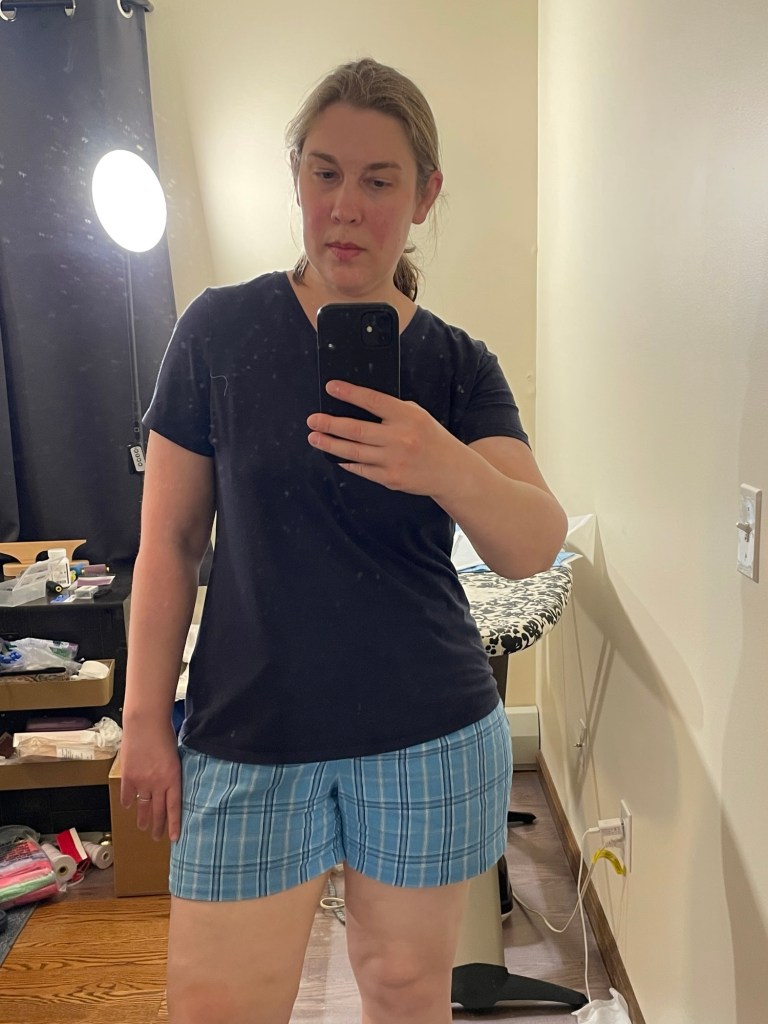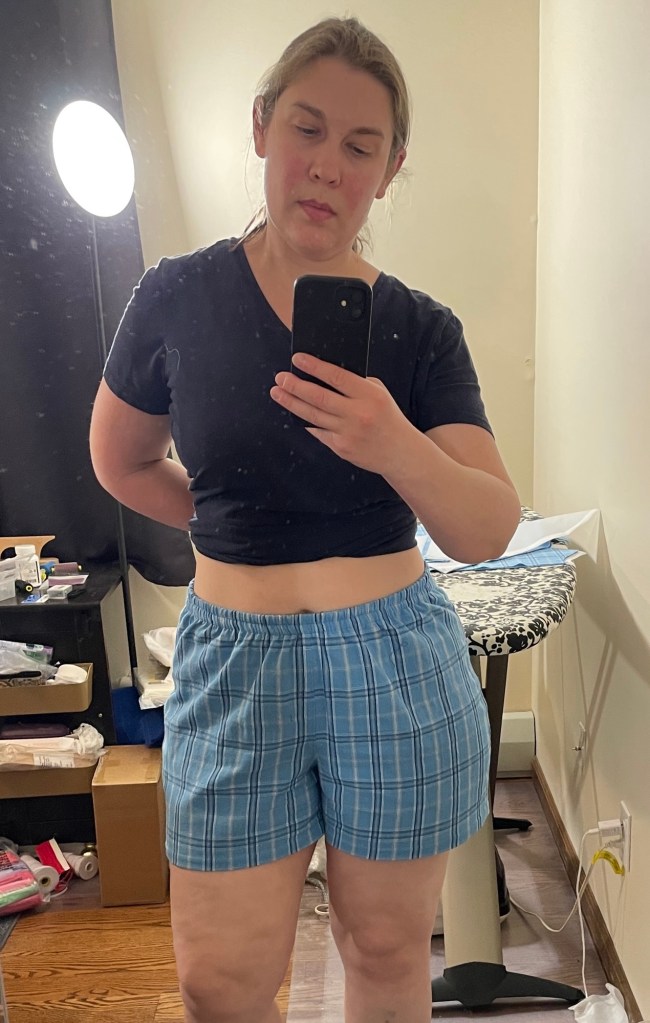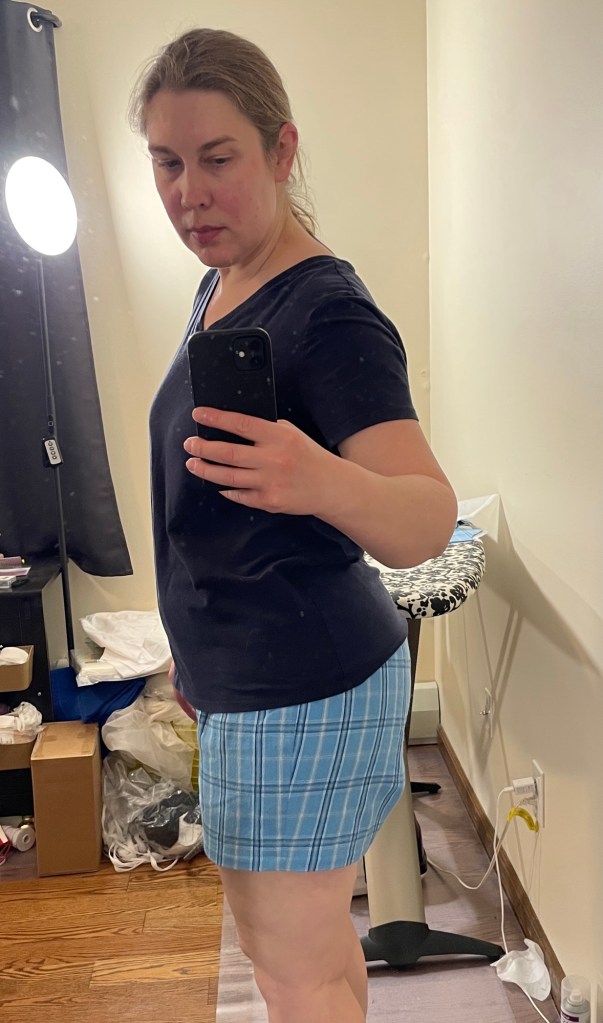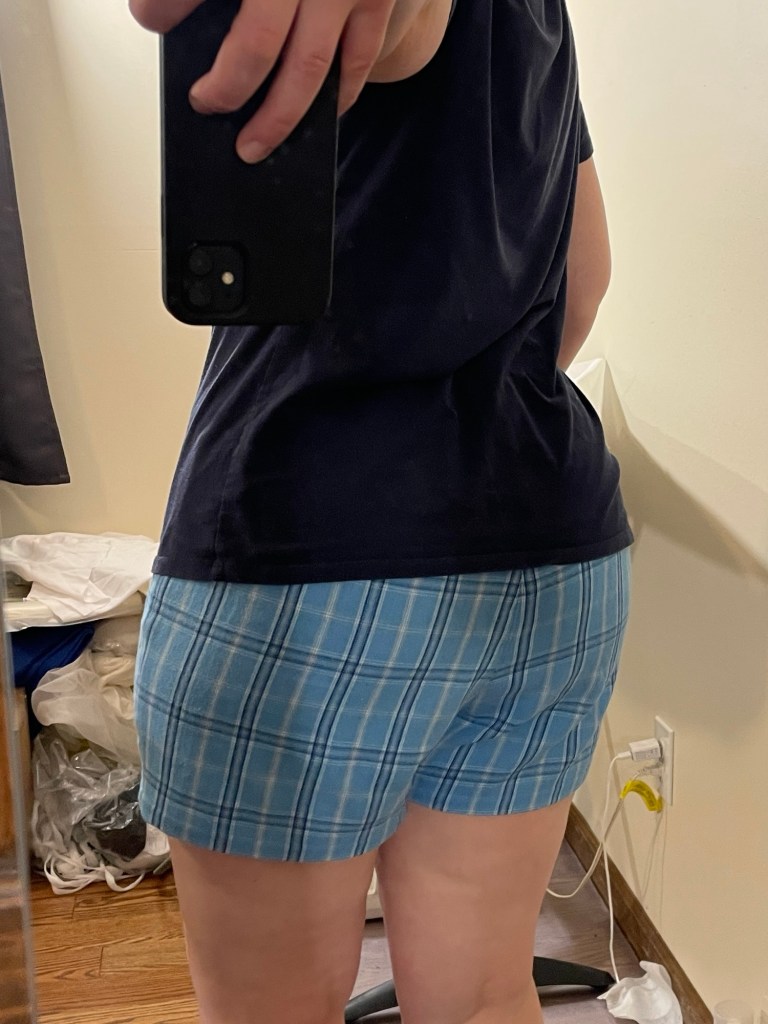
Style Arc Cruising Kate pants

Here’s the Style Arc Crusing Kate, made out of a black rayon/lycra jersey bought about 6 years ago from Fabric.com. (Jacket is the Style Arc Stacie and shirt is Vogue 8772.

The front:

IMG_4938

And the always scary back shot:

IMG_4929

As drafted the Cruising Kate pants have a 21.5″ inseam and sit on the natural waistline. The waistband is 3″ wide. There’s a slight amount of positive ease through the hips and as you can tell from the photo above the legs are cut somewhat loosely. The legs have a 16.5″ opening at the hem and have a gradual taper, which surprised me a little as from the technical drawing they almost look like they have a slight bootcut. Maybe they look more bootcut on someone with slimmer legs :) .

Since it isn’t quite summer yet I decided to make them full length. I lengthened them a total of 12.5″ from the drafted length and straightened the leg a little, making the hem 20.5″ wide. I didn’t prewash this knit so I left them a little bit long in case if the fabric shrinks.

My fitting adjustments were:

  • Lengthened the rise 1″
  • 1/4″ full thigh adjustment (front only)
  • Shifted the legs inward 3/4″ in the front and 1″ in the back
  • Lengthened the legs 1″, only to shorten them 2″ during fitting
  • Added 3/4″ to the CB
  • Scooped out the back crotch curve 5/8″

The back still needs a little bit of work though. I think I’m going to try the adjustment where you slash the leg horizontally directly below the crotch curve and rotate it so the inseam is shortened and the outseam is lengthened.

I think this is a good pattern if you want uber-comfortable knit pants and do not want something as tight as the Becky yoga pants. It does need a lightweight knit without a lot of drape though or else it doesn’t hang correctly. Rayon/lycra jersey is perfect, as is ITY or even matte jersey.

A Very Useful BabyLock Evolve Accessory

I used my new BabyLock Evolve clear foot today. It makes using my Evolve so much more pleasant, especially when coverstitching.

BabyLock Evolve clear foot

I’m planning on leaving it on all the time now. I don’t know why this doesn’t come standard with the machine.

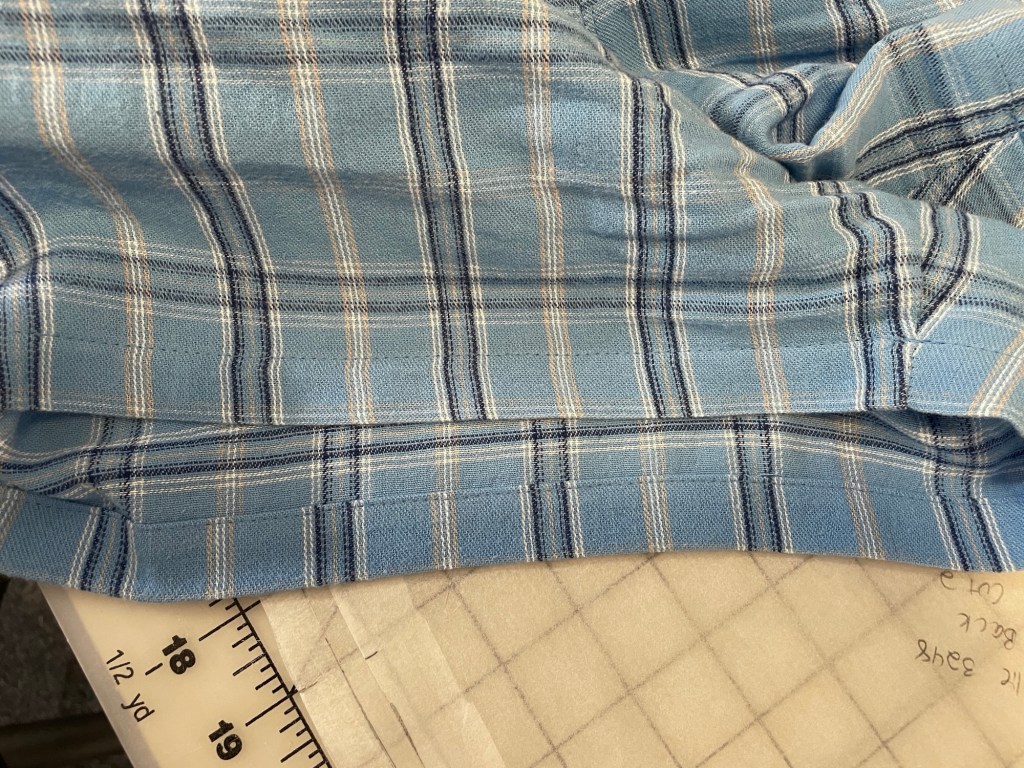
I can actually see well enough now to neatly overlap the end of the stitching when hemming instead of looking like it derailed at the end:

IMG_4926

You can buy the BabyLock Evolve clear foot online from Sharp Sewing’s eBay store.

In case if you’re wondering what the project was, it was the Style Arc Cruising Kate pant and Style Arc Kate top. Will post more about them once I have photos.

Liebster Award

Jess from the Sometimes Sewist decided to honor me with a Liebster award. Thanks Jess!  In order to accept I need to answer 10 questions…here they are:

1. If you could spend an afternoon sewing with anyone in history, dead or alive, who would it be and why?

Kathleen Fasanella from Fashion Incubator. I love her analytical, no BS approach (reminds me of talking to my engineer brothers) and how she stresses accuracy and not making something more complicated unless it is going to improve the final result. Her suggestion that home sewers generally don’t use enough interfacing was an eye opener, and the posts she wrote on sleeve cap ease and anatomically correct armholes also helped clear up things for me. Because of her I now cut almost everything out on a single layer using weights and a rotary cutter and always interface instead of using staystitching (which I always considered an inferior method).

2. If you could have up to five yards of any fabric in the world for free, what would you choose? (“Bonus” points for a picture)

Easy – vicuña! It is a mysterious fabric that Marfy sometimes mentions as a recommended fabric for coats or suits and goes for something crazy like over $4,000 a yard.

I don’t have a picture of the fabric, but this is what a vicuña looks like. (Photo credit: The Peruvian Connection.)

vicuna-detail-01

3. What would you make with the mythical unicorn-like fabric from question 2?

I would make Marfy 2918. Then I would be terrified to wear it.

CCI08112012_0023

4. What’s your favorite fruit or vegetable?

BACON. I will eat any vegetable provided it is sprinkled with bacon bits.

5. What’s your favorite non-sewing project of all time?

I took a drawing class 6 years ago and really enjoyed it. My drawings were not technically great but I was decent at it and learned a lot. I kept all of my artwork from it. I eventually want to get back into it again.

6. What’s your favorite aspect of sewing?

I very much enjoy the creativity and technical process that leads to a finished product that is actually useful. Surprisingly, I also love fitting. Fitting is what makes creating clothing so interesting to me, and sometimes it really is a feat of engineering to get a 2 dimensional piece of cloth to fit a three dimensional body and have it look good. If I just wanted to sew I would quilt or make handbags. I need a new bag and have the pattern and all the supplies for it, but it just seems so dull when compared to making a new dress.

7. What’s your dream job?

I’m in the process of teaching someone how to sew right now and it is a very satisfying experience.

8. What’s your favorite era in fashion, and why?

I don’t really have one in particular. I think almost every era had its hits and misses. The 1930s had those gorgeous slinky gowns and the 1950s were very feminine. About 10 years ago bootcut jeans were all the rage and when worn with heels made everyone look like they had long legs. The stronger shoulder line from the 80′s was great if you were pear shaped and wanted to balance out your figure.

I’m not a fan of skinny jeans (which make a lot of otherwise normal figures look anything but skinny, IMO) and the trendy oversized tops with the banded bottom are the last thing I should be wearing, but one thing I really like about current fashion is that you do have complete freedom to wear whatever you want. There’s also very little stigma about thrifting, which I don’t think was the case 10 years ago.

9. Is there any type of clothing that you’ve always wanted to try making but have never attempted? If yes, what is it?  Also, what’s stopping ya?

A structured coat with a bagged lining was previously on my sewing bucket list, but I can cross that off now. Now it is a strapless boned bodice, heavy interlined winter coat, and a suit.  What’s stopping me? Lack of needing them right now. I bought a very warm down coat from Land’s End this winter for less than $70 on clearance so that took care of the warm coat. I don’t really have anywhere to wear the strapless bodice, and my workplace would think I was interviewing somewhere else if I wore a formal suit!

For the upcoming year I plan on making more lined jackets. I have a whole bunch of jacket patterns from Style Arc now so there’s no excuse to keep putting it off! The fact that Style Arc doesn’t have stupid amounts of ease in their patterns and includes pattern pieces for the linings, fusibles, and facings makes it a less daunting goal.

10. What’s your favorite part of blogging?

I love the feedback and how people actually find what I write useful. Locally I don’t know anyone my age that sews so it allows me to have connections that I would otherwise never have. I have learned so much from other people’s blogs, and it is always interesting to see what people are coming up with.

Style Arc Stella Wrap Coat

This is the first tailored coat I’ve ever made. I took me almost a week to complete – 1 day to cut out and adjust the pattern, another day to cut out the fashion fabric, 1 day to cut/fuse the interfacings, and 2 days to cut out the lining, sew, and press the finished product.

IMG_4888

This coat is partially to fill in the spring coat gap of my wardrobe, but also to fully test out this pattern and to practice my tailoring and coatmaking skills before I take on something more complicated (like a lambswool interlined wool winter coat). Kind of like a wearable muslin, but with more careful stitching. I didn’t serge the seams though as the lining will help protect things, and I made this for the learning experience and really don’t care if it lasts more than a year or two.

The Stella is slim fitting for a coat. Notice how the back has very few gathers at the waistline.The sleeves have about 2.5″ of ease, so if you layer or want to wear a heavy sweater under it you will probably need to add some width.

IMG_4897

The fashion fabric is a hefty Italian cotton double-faced twill from Mood, and lining is a nylon taffeta from Fabric Mart that ended up being a really good color match. The lining and fashion fabric were a total of less than $30.

IMG_4903

Since this is a rather thick and sturdy cotton I constructed and topstitched the outer shell on my Seiko STH-8BLD-3 using Gutermann Mara 30 thread. Gutermann Mara 100 is “normal” weight thread and Gutermann Mara 70 is somewhere between the two, and more suitable if you are stitching on a domestic machine. This machine topstitches like a BOSS. Unlike my Janome it doesn’t struggle at all getting going after pivoting a corner, and I can use this Mara 30 thread in the bobbin as well as on top. When I tried to stitch with this thread on my Janome it kept pulling up the normal weight bobbin thread, and completely broke the needle when I tried it in the bobbin as well as on top. Anyway, this project gave me a good excuse to try out my Seiko’s new 1/4″ topstitching foot.

IMG_4905

For this project I used lots of different interfacings. The front, back yoke, and front facing is fully interfaced using the lightweight Pro-Weft from Fashion Sewing Supply. For the sleeves, hem, armholes, and outer collar I used the medium weight Pro-Sheer. Lightweight Pro-Sheer was used for the back yoke facing and belt, and Pro-Tailor fusible horsehair was used for the inner collar. For the sleeve head interfacing I used the medium Pro-Weft. Style Arc included the pieces for the sleeve head and sleeve hem interfacing. I kind of guessed on the interfacing. My choices ended up resulting in a fairly structured coat. If I wanted something softer next time I would interface the front in Pro-Sheer instead.

Fitting adjustments were a 1/4″ broad back alteration, adding 1″ of length to the sleeves, and adding 2″ of length to the coat with an extra 3/4″ of length at the CB. I also added a total of 5″ to the hips and 3/4″ to the sleeves. During fitting I took in the CB seam 5/8″ (removing a total of 1.25″) from the lower waist all the way down to the hem.

When I was cutting this out I made sure to allow for turn of cloth by trimming down the inner collar and the lapels of the front. My general rule for turn of cloth is 1/8″ for lighter fabrics and up to 3/8″ for heavy fabrics. I went with 5/16″ for this one.

I really appreciated how Style Arc included the lining pieces. One thing that has made me hesitant to make a Burda jacket or coat is that they expect you to draft your own lining. I know it isn’t impossible but I prefer to limit the amount of new things I have to learn for one project.

This is the first time I ever bagged a jacket/coat. I followed this tutorial by Grainline Studio. Gigi also has a great visual tutorial on bagging a coat. She learned this method from this original post, which is one of the nameless tutorials written by Kathleen Fasanella of Fashion Incubator. By combining the visuals from these tutorials I somehow got a bagged lining. Of course I managed to get both sleeve linings twisted. Yes, BOTH of them. I rescued them by slitting an opening in the sleeve lining, untangling and resewing them from the opening, then closing the slit and stitching it closed by sewing extremely close (1/16″) to the edge by machine. I think I may just leave an opening in both sleeve linings next time and attach the sleeves through that as I can totally see myself doing this again. Due to the bulk of the coat, instead of pulling it through the sleeve opening I pulled it through the front facing opening.

I’m not sure if my struggles with bagging the lining were due to never doing it before or the fact that I had spent all afternoon and a good chunk of that evening sewing and was just tired. All I know is that I got so annoyed I ended up chucking the partially bagged coat in the corner of my sewing room, only to pick it up the next day and decide that I was going to make it work, if only for the learning experience! I felt a lot better once I fixed the sleeves and starting pressing it. It started looking like a real coat then instead of a lumpy mess.

The other thing I got annoyed at was turning the belt. At first I left the seam allowances as-is but it did NOT want to turn. I then undid what I had turned and trimmed the seam allowances down to 3/16″. Still had to spend some time turning it, but it went much quicker the second time around.

Would I make this coat again? Absolutely! For once I have a coat that is long enough in the arms and cut wide enough for my arms and bottom half, with the waist shaping in the correct spot. It is a neat twist on the classic trench but isn’t too weird, and the fact that Style Arc includes the pieces for the lining, fusibles, and facings saves time and helped me make this coat a success. I also really like how there’s no closures, which saves time and takes finding the perfect button out of the equation. I have a navy wool twill with a coordinating lining sitting in my stash, waiting to be made into Version 2 of this coat.

Rayon Doubleknit Style Arc Becky Yoga Pants

Very quick morning project because I badly needed a pair of yoga pants that weren’t fleece. I’m going to be brave and show them from all angles.

IMG_4882 IMG_4884 IMG_4886

My fitting adjustments were:

  • lengthening the rise 1″
  • adding 3/4″ to the CB seam
  • shifting the legs inward 1″
  • removing 4″ from the waistband
  • removing 1/4″ from the CF seam
  • lengthening the legs between the knee and hem 2″. It looks like I could have done another 1″ but the again I might be stepping on the hem while barefoot. (FYI as drafted the inseam length is 31.5″.)
  • Making the CF crotch curve shallower by adding a generous 1/4″ to the mid-hip level, right above the curved part. It now looks slightly more slanted:
    IMAG0931

The negative ease is gives a very close fit, but these felt much more reasonable than my fleece pair (which were almost on Spanx level). Next time I make a fleece pair I will add 1/4″ to each side seam to account for the extra bulk. You can also see from the photo above that next time I will do a 3/8″ full thigh adjustment in the front, as it feels like it is slightly pulling in this area.

Another fitting adjustment I made was removing a total of 4″ from the back waist. Normally I remove this from the center back seam, but it seems like it causes the CB seam to ripple. Plus it also seems to contribute to weird wrinkling under the butt. My theory was that taking in the CB seam was causing it to be too much on the bias. So this time I removed that 2″ from the side seam area of the back piece only. I removed 1/2″ length from the top to make it match the front piece’s side seam length.

IMAG0930

The final result pleased me. The CB seam has no rippling and this takes care of the gaping at the CB. I’m going to try this with a woven pair of pants next time and see if it gives the same result.

White Stretch Twill Style Arc Stacie Jeans Jacket

Horrible, horrible quality camera phone photo that completely fuzzes out all my topstitching…but considering that I cut out this jacket after dinner last night and finished it sometime at midnight there wasn’t any time for a decent photo. Maybe tonight. I just wanted to get it done so I could wear it with my Anthea dress today and celebrate the good weather (high of 77 today!). It is one inch shorter than my purple denim version, which makes it a better length for wearing with flared skirts.

IMAG0921

Here’s a clearer photo taken with a real camera. You can see how I already managed to get dirt on it! Oh well…IMG_4841

The fabric is a Theory 97% cotton/3% lycra twill from Mood Fabrics. I constructed the entire jacket using Gutermann Mara 70 thread. It is a light to medium weight topstitching thread, not as thick as Mara 30. Very good for a lighter weight twill like this. The Mara 30 is better if you are sewing something like a coat or jeans. My Janome handled the Mara 70 decently but struggled when it came to topstitching some areas. Next time I made this jacket I will use my Seiko.

All snaps were set using my fancy new Pres-N-Snap tool. I used the antique copper anorak snaps from Cleaner’s Supply. They are extremely secure (don’t move at all when I try to spin them) and I yank them apart with no worries. Notice how the button caps are smooth with no distortion. I did stabilize the band facing with some Pro-Sheer Elegance fusible from Fashion Sewing Supply. I’m not sure if it was necessary but I didn’t want to take any chances because of the lycra content. IMAG0928

Style Arc Anthea Dress

Finally hemmed! Probably should have waited until daylight to do pictures, but I couldn’t wait :)

IMG_4832

By some miracle I even managed to get the pattern to line up in the back:IMG_4822

I had been sitting on this Alice+Olivia silk crepe from Sawyer Brook for a while now, trying to decide on the best pattern to use. It was one of those fabrics that I fell in love with but had no clue what I was going to make out of it. I was thinking of a Sewaholic Cambie but I wasn’t completely happy with the fit of the bodice and didn’t want to commit this fabric to it. Due to the large print I wanted something extremely simple. The Style Arc Anthea seemed like a good match.

Style Arc describes this as a boat necked dress with a flared skirt that’s about 22.5″ long. The front bodice has horizontal and vertical darts and the back bodice has vertical darts for shaping. The skirt has no darts at all and is cut on the straight grain, but it is flared so wide that the side seams end up being completely on the bias. This is why I let it hang a while before hemming it. I was mostly going for not too obviously uneven – this fabric is so lightweight that whenever I move the hem is thrown off again.

I made no design changes. Fitting changes were:

  • Lengthened the waist 1″, putting the CB of the waist seam at the 16″ mark
  • Added 4″ total to the hips
  • As with the Layla dress, I found the front darts to be too straight. I made them convex, curving each dart line outward 1/4″
  • 1/4″ sloped shoulder adjustment
  • Lowered the bust darts 3/8″
  • Lengthened the upper back between neck and bottom of the armhole 1/4″
  • 1/4″ broad back adjustment
  • Added a 3/4″ dart to the back shoulder seam
  • Added 1.25″ length to the CB, splitting it evenly between the upper edge and hem of the skirt
  • Removed 1/4″ from the lower CF of the front bodice

Things I liked:

  • The neckline is wider than a crew but narrower than a typical boat neckline. This is great for someone like me that has narrow shoulders. It broadens the shoulders more than a crewneck but doesn’t show bra straps. 
  • The skirt! No darts, flared, and very flattering in a lightweight fabric.
  • The fit of the bodice was great. No extra bagginess at the bust or waist (I think there’s no more than 1″ of ease) yet it doesn’t feel constricting at all.
  • As shown above, the simple style is perfect for prints!
  • They included pattern pieces for the neckline and armhole interfacing “stays”, which is a thoughtful touch. It preserves the shape more than strips of Design Plus fusible stay tape do.

I didn’t dislike anything about it.

I do think the shoulders ran narrow on this. I usually take in Style Arc shoulders 1/2″ and I didn’t take in these at all, so that’s definitely something to take a look at if you are average to broader shouldered.

My Style Arc Tiffany is my go-to pattern for silk blouses, and I think the Anthea is my new go-to dress pattern for lightweight printed fabrics.

Style Arc Heidi Hooded Cardigan

…made out of a cotton/wool double faced knit that was a Fabric Mart Julie’s Picks. It was perfect for this cardigan. IMG_4806With the exception of applying the pockets I was able to do this project 100% on my serger. The instructions Style Arc provided were good with the exception of completely skipping on attaching the hood! They jumped from sewing the side seams to attaching the front band. Oh well, I would rather have an instruction mistake than drafting mistake.

The only style change I made was skipping on the hood facing.

Fitting adjustments were:

  • Added a CB seam for shaping, which I ended up taking in at the waist a total of 5″
  • Lengthened the waist 2.5″
  • Lengthened the sleeves 1″
  • 1/2″ narrow shoulder alteration on the front only
  • 1/4″ broad back adjustment
  • Added 1″ width to the sleeves (I thought they ran a little narrow on this considering it is a cardigan and most likely will be layered)

One other thing I did was hand stitch the bottom of the front band seam allowances in place. They are bulky and this helped keep them where they should be.

The pros of the Style Arc Heidi are that it is practical, easy to construct (hem, sleeve, and front bands remove the need to coverstitch!), and well drafted. All the pieces fit together well and the notches match up. The hood facing is a great idea that eliminates ugly seam allowances from showing when the hood is worn down and gives it a finished look if you are using a knit that has an “ugly” side (mine did not so I skipped on it). Another nice thing is that the single closure in the front allows you to use a plain snap or button, but you can also use a statement button or even a brooch. The length makes it very cozy. If you are short some fabric it is easy to colorblock the bands.

The cons? I’m not crazy about how it looks on me. I feel like the length and the pockets widen my hips.  I consider myself pear shaped and evenly proportioned (neither long nor short waisted). I think this cardigan would look best on someone shorter waisted. I also think it is a style and length that works best when worn with skinny jeans or leggings and I’m a bootcut/wide leg girl.

UPDATE: I paired it this morning with my Burda 09-2006-115 silk jersey wrap dress, and I think it works better with the slimmer leg:[UNSET]

Despite not feeling 100% confident that it is the most flattering style on me when worn with my usual pants I’m going to keep it. It will be good for wearing on rainy days and when going for errands. For a future version that will be worn with pants I would try cropping it about 11″ so it hits at the mid hip level.

Style Arc Wendy Pants

My new Style Arc Wendy pants, photographed on this very overcast morning. I made them out of a heathered grape RPL from Gorgeous Fabrics. The blouse is a Style Arc TiffanyIMG_4799These are the first pair of woven Style Arc pants I have ever made. They’re very comfortable. I chose this particular pattern because they are lower rise than the Linda and the waistband has a concealed opening. I emailed the Style Arc team and asked about the type of fabric they recommend aside from stretch bengaline. They said my 15% stretch wovens should work and attached a photocopy showing that the woven they used had 4% lycra. (See how helpful they are?) The sample fabric attached must have been stretch bengaline, and I can see why people rave about it so much. It has the look of a woven but the stretch of a knit, and has a very snappy recovery and doesn’t look like it would cling. What a shame that it is impossible to find in the United States!

Fitting changes were adding 1.25″ to the CB seam, shifting the legs inward 1″ at the back knee and 3/4″ for the front knee, and making the front crotch curve shallower by 1/4″ (meaning I extended the line outward). I could have extended it outward some more because there’s still wrinkles in the front. (I have what my fitting book would call a “recessed pubic bone” and Style Arc must draft for a more prominent one.) I also lengthened the inseam 2.5″, took in the back waist a total of 2.5″ at the upper edge of the waistband, and added 1/4″ to each outer sideseam from the hip downward. I had to scoop out the back crotch curve a little bit because in the process of taking in the CB seam some of the length I added got cut off. My fit is not perfect yet but it is still much better than anything I could buy.

Design changes were making the legs bootcut by adding 4″ to the bottom leg width and adding a front zip. I happened to use an invisible zip, but using a regular zip with a fly and shield is also an option. I also didn’t interface the waistband because this fabric already had a good snappy stretch to it.

For being such a simple pant I actually had a lot of trouble, which I think is entirely due to my pear shape, the lack of a front zip, and fabric choice. I made several muslins before I gave up and decided to add a front zip. I chose a light gray color to match the heathering of the fabric. Without adding the zip was no way I was going to be able to get the waistband to fit and have them go over my hips without being in danger of ripping them! I also made a couple of muslins out of some heavier stretch cottons and that’s how I found out that stiffer fabrics do NOT work with this style. I would say the best fabrics for this are RPL, stretch wool, and any other woven fabrics that have 10-20% stretch but good drape.

One thing I found interesting was the back crotch curve was very similar to my TNT Sewaholic Thurlow trouser pattern. Basically the back crotch length was longer and the crotch extension shorter than most pants pattern. I wonder if that’s the secret to the good Style Arc fit.