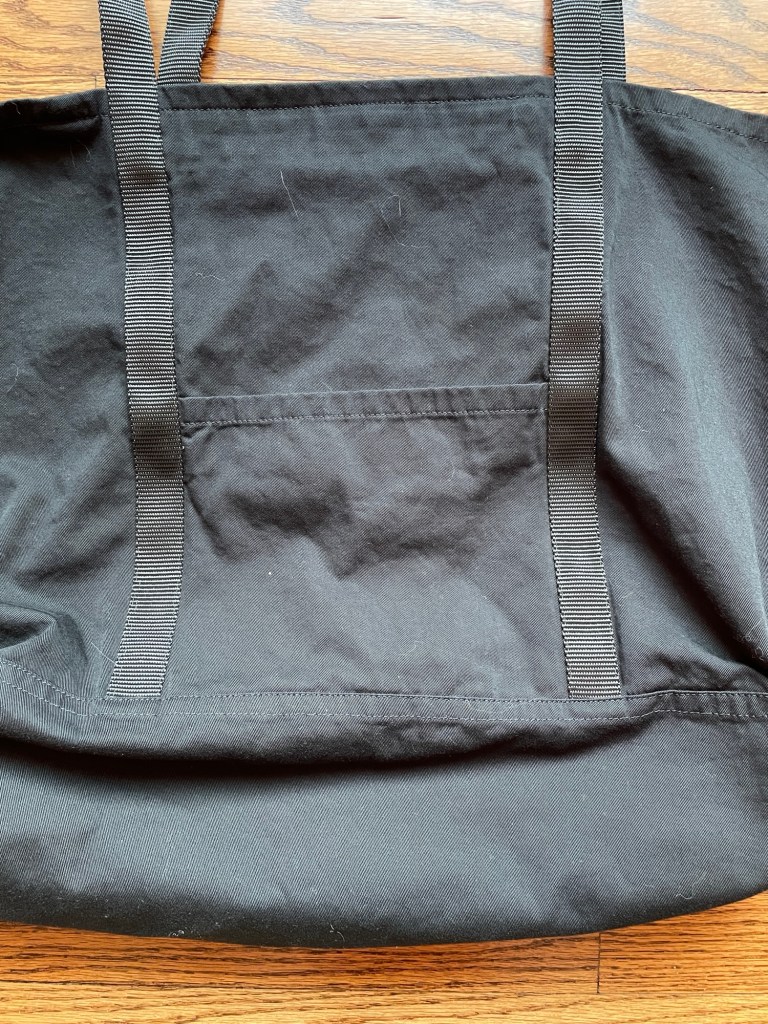
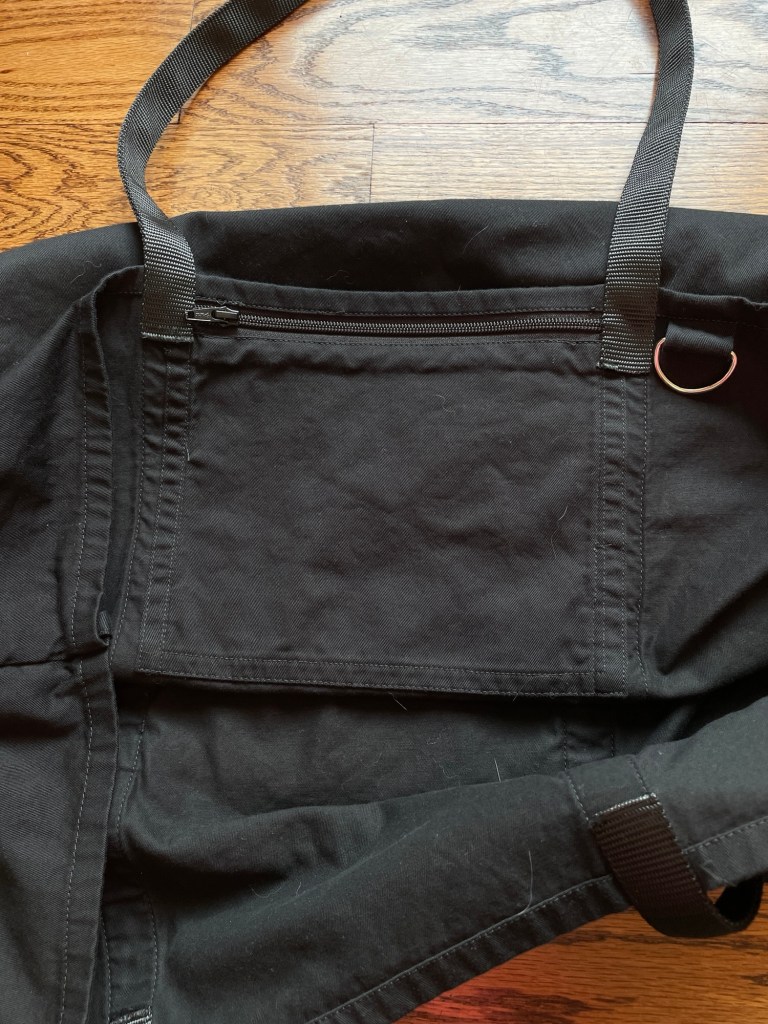
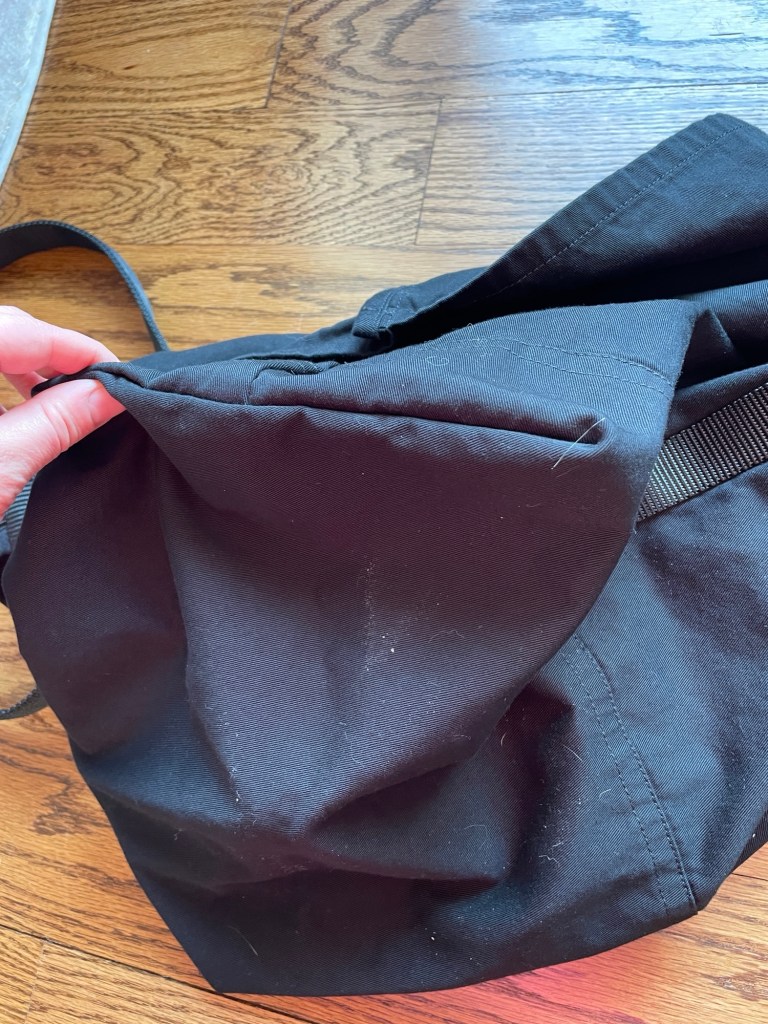
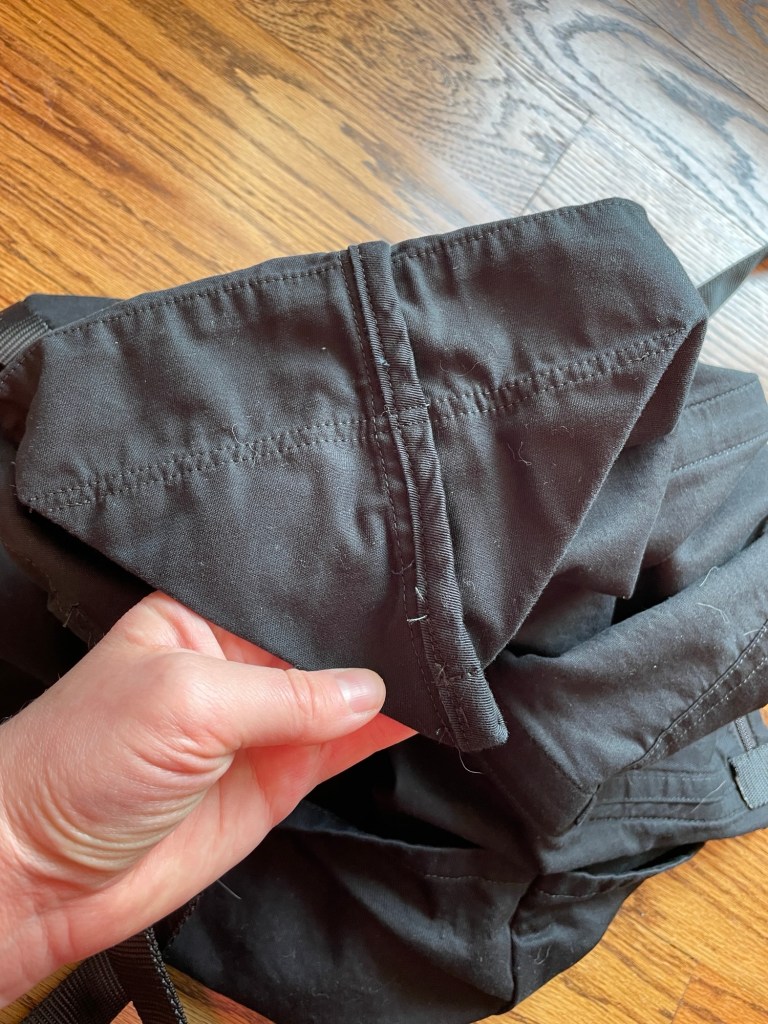
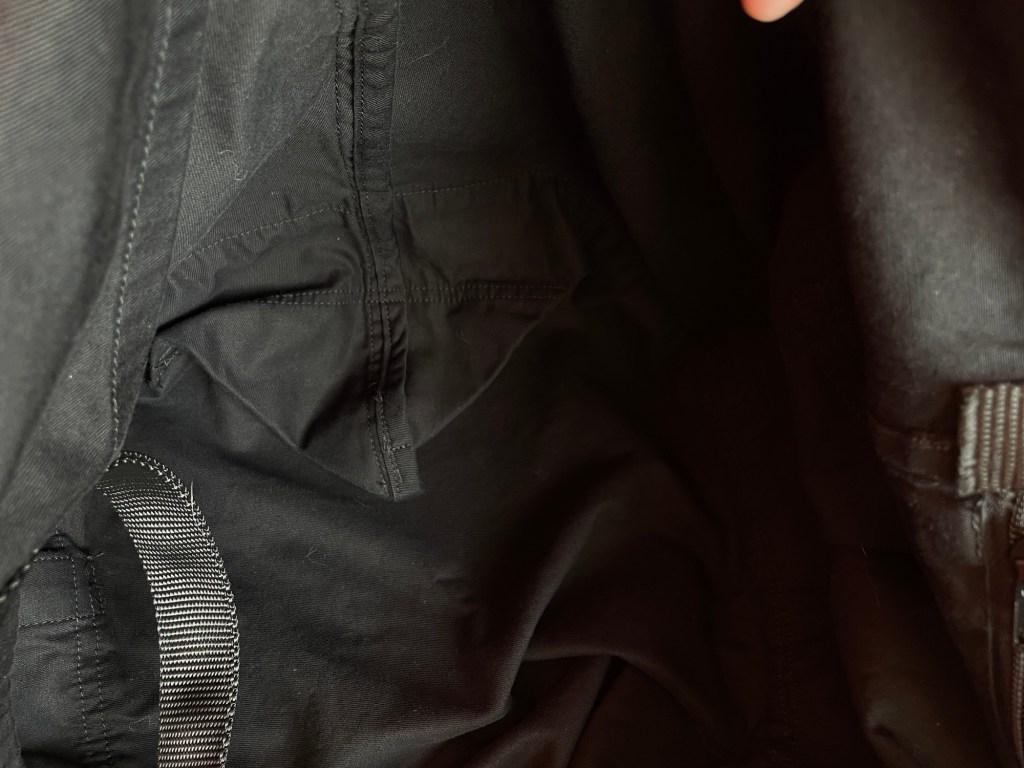
Inside pocket with D-ringOutside constructed corner of toteInside constructed corner of toteTote corner tucked inside
This was kind of a spur of the moment project for me. I wanted to do something a little different from garment sewing and decided to venture into bagmaking. My toddler has been maxing out his diaper bag lately between potty training but still using diapers, bigger clothes, snacks, etc. I’ve been keeping a backpack in the car with the lesser used stuff and a medium size LL Bean tote for his more frequently used stuff and have been wanting to consolidate into one bag because I also tend to keep some of my own stuff in his diaper bag. This pattern was attractive to me because it is simple and uses minimal speciality materials.
Background
The Rugged Tote and Portfolio from The Green Pepper is an unlined tote bag with optional exterior pockets, a zipped interior pocket, and D-ring for keys. You can use either webbing or self fabric for the straps, which come in regular and long lengths. The bottom of the bag is actually a double layer of fabric, as a separate bag bottom is sewn onto the main body of the tote. If you made it out of 25 oz canvas it would be very similar to the LL Bean Boat and Tote.
The tote and portfolio styles use the same pattern pieces. The only difference is that you sew the corners of the bag into a triangle at the end to make the tote version.
There are four tote sizes, listed below as height x width x depth:
Small: 11.75” x 9.5” x 5”
Medium: 13.25” x 13” x 6”
Large: 15” x 16.5” x 7.5”
Extra-large: 16” x 19” x 8.5”
These roughly correspond to the size of the LL Bean Boat and Tote bags.
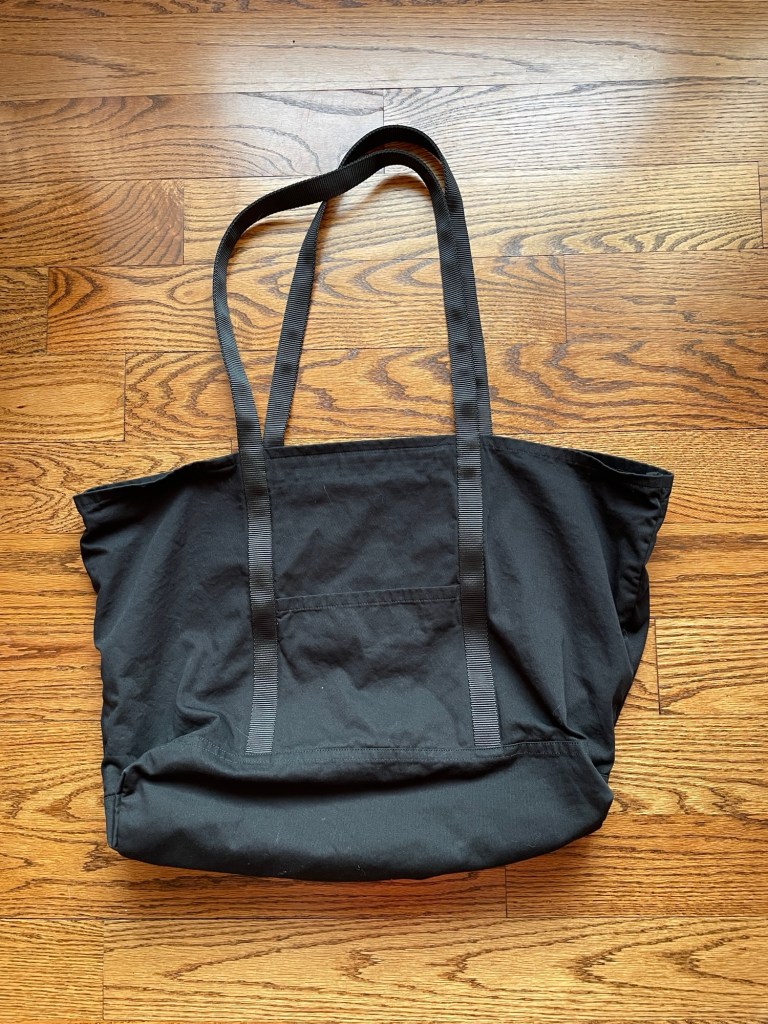
I made the extra large tote with the long straps and all of the optional pockets and D-ring.
Materials
Recommended fabrics are sturdy midweight to heavyweight fabrics like denim, canvas, and Cordura.
I used a midweight black 100% cotton twill I had in my stash for over ten years. For the straps I used nylon webbing. The zipper is a #5 nylon coil zipper from Wawak that was also in my stash. I used Gutermann Mara 70 thread for all construction.
The keyring was a 1.25” D-ring I’ve had in my stash forever from Bagmakers Supply.
Construction
I thought the included instructions were pretty good. I just was working very late at night and got confused about the zipper and how the ends of it were secured close until I went further along and realized that the inside strap actually covers it.
Jalie 2111 is a classic men’s shirt pattern. It has a relaxed fit with a back box pleat, banded collar, and shaped hem. Both short and long sleeve pattern pieces included in the envelope. The cuffs have two buttons so you can wear them either tighter (like my son is in the photos) or looser, depending on your preference. The long sleeves have a shirt sleeve placket with a button. There’s also a chest pocket but I chose to leave that off this time.
Sizes go from 2T (22” chest) all the way to size XXL (47.25” chest). The wide size range, in addition to the timeless style, is what sold me on this pattern.
This is an older pattern, from 2001, so while it is no longer in print you can still buy it as a digital pattern. I ended up having it printed using the website PDFplotting.com. I used the higher quality paper available and found the service reasonably priced (if you do a bulk order like me) and quick to arrive. Highly recommend this service!
Alterations
I cut a size 3T. My son is on the verge of outgrowing European size 92 right now (2T) so I cut a size 3T just so he would have more time to wear it. I added a total of 2” around the hips because he still uses cloth diapers and needs the extra room.
Fabric and Notions
I used a 100% cotton shirting from Fabric Mart. The buttons were from WAWAK. I used a lightweight shirt crisp cotton interfacing from Fashion Sewing Supply for the collar band, collar, and cuffs.
Construction
I was happy I made time to work on this project, as it was my very first project using my new Juki TL-2010Q. This shirt was great for getting to try out my new presser feet as well as just get used to the feel of the machine. I was super happy with how the machine performed. I finally got used to using the machine threader and the feel of the presser foot (which has the auto thread cutter built in). And unlike my Janome 6500, the auto thread cutter works GREAT and doesn’t leave any ugly thread nests.
One of the nice things about this machine is that it can use regular industrial feet, which can be found for very cheap. For this project I used my new compensating foot set, topstitch guide set, and rolled hem foot set. I was particularly impressed by the performance of the rolled hem foot. It had no trouble at all going around the shaped hem and did a perfect job the first try. My Janome foot, by comparison, struggled to feed anything other than a perfectly straight edge.
I didn’t have the best of luck with the old Greist/Singer buttonholer for the buttonholes. For some reason the stitches kept skipping so rather than continue to fuss with it I just used my Janome 6500 and automatic buttonhole foot. For some reason I still had a bit of skipped stitches at the very start top of a few buttonholes, but a zigzag with the feed dogs dropped was able to save them.
The instructions included with the pattern are typical of the older Jalie patterns and not the best. In particular, the section for how to construct the front button band was rather confusing and I ended up redoing it before finally understanding what they meant. Another part of the instructions were wonky where the illustrations for the final steps are randomly thrown in the middle of the illustration for some middle steps. I might do a sew along and take a bunch of photos the next time I make this shirt.
Conclusion
My son loves how dapper he feels in his new shirt! He had no problem at all moving around in it to play outside today for 3.5 hours. It can be hard finding long sleeve button down shirt patterns for smaller sizes so I’m glad Jalie still offers this pattern.
Just got this baby delivered yesterday! I haven’t made a space for it in the sewing room yet so I set it up on my dining room table for now.
My primary sewing machine for the past 20 years has been a Janome Memory Craft 6500P. My mom bought it a year before I caught the sewing bug, and when she saw how much I fell in love with sewing she decided to give me her machine and bought another one for herself. It’s been a great machine and I can’t even tell you how many hours I have on it. However, it does have some quirks:
The automatic thread cutter sucks. It has sucked from Day One. It always leaves a big thread nest unless I use a leader cloth, and if I need to use a leader cloth all the time I feel like it’s quicker to just use the built in manual thread cutter and snip the threads afterwards
It sometimes it goes for another stitch or two after I stop stitching, especially with heavier weight materials. I’ve seen other people complain about this.
Regular buttonholes are super easy and good quality, but it struggled with making nicely rounded keyhole buttonholes, especially on heavier fabrics.
When Juki Junkies advertised last month that they were going to sell the Juki TL-2010Q floor models being used at Quilt Con at a discount, I decided to go for it. Right now this machine sells for around $1200. I got mine for $950 with shipping included. My husband didn’t really understand why I wanted it, but when I said it would take the place of birthday, Christmas, anniversary, Valentine’s Day, Mother’s Day etc gifts for the next two years he thought that was a pretty good deal 😂.
This machine is marketed for quilters and bag makers. Nearly everything I sew is a garment. Now why did I want a straight stitch only machine like this?
I have a compound walking foot industrial (the Seiko STH8-BLD-3). I don’t use it very often because it is for heavy materials, but I love how it is simple, super reliable and feeds everything through with ease. It does one thing, but it does it really well. It will never die and likely outlast me. I wanted this same experience with a machine that handles lighter fabrics. After going through two expensive sergers that performed beautifully but ultimately failed due to their complexity, I just wanted something simple and reliable.
If I had the space I would have probably gotten the Juki 8700 industrial; however, my sewing room is a small spare bedroom and between my four other machines (Janome 6500, Janome MyLock 204D serger, Janome 300e embroidery machine, Janome Coverpro 2000CPX coverstitch) and my cutting table, ironing board, etc I just don’t have the room. (As it is now I have to keep the Seiko in my basement.)
Speed! My Janome maxes out at 1000 stitches per minute. The Juki does 1500 stitches per minute.
The Juki allows you to use a lot of industrial sewing machine feet, which are often much cheaper and more effective than domestic sewing machine feet.
As I mentioned before, my current Janome is 20+ years old and being computerized, I have no idea how long it is going to last. I know that parts are getting harder to find for it.
My Juki Tl-2010Q just arrived a day ago so I haven’t had much time to sit down and play with it yet, but so far I am very happy with its performance. It feeds the fabric easily and I feel like the presser foot design makes it easier to topstitch, especially around corners, without a guide. The thread cutter also works GREAT!
The automatic threader sucks! My Janome is so much easier to use. Despite some practice I am just threading it by hand more often than not.
There’s a learning curve to the foot pedal. You have to be careful to not hit the back of it or else it activates the automatic thread cutter. I believe there’s a piece you can buy to prevent this from happening, but it’s another $20 added to the purchase price.
Now for the big test…buttonholes!
My mom recently gave me an old Singer branded buttonholer which was probably from the late 60s. My dad worked a bit back then as a machinist at the Griest buttonholer factory in New Haven, Connecticut. He ended up leaving the job less than a year later because it was mind numbingly dull, but while he was working there he brought home a Singer branded Greist buttonhole attachment with all the cams for my mom. She used it for a while but eventually switched to one of the first computerized Viking machines.
I wasn’t sure if it would work with my Juki since it is a high shank machine (and the high shank Greist buttonholers are apparently harder to find) but I can confirm that it does work. Maybe those photos will help those looking on the secondhand market for a vintage buttonholer to fit their Juki,
Here are some action photos, along with a video of me doing the second pass for the larger keyhole buttonhole. I used three layers of a midweight 100% linen and Gutermann Mara 120 thread.
First passSecond pass
Second pass of larger buttonhole
Now for some finished samples. I think they came out great!
Finished frontFinished backSmall vs larger keyhole. I used a wider stitch width for the larger one.
If you’ve never used one of these attachments before I found this tutorial very helpful. I don’t recall if the video tutorial mentions it or not, but make sure you drop your feed dogs before attaching the plate! It was late at night when I first tried using this attachment and I couldn’t figure out when I turned the hand wheel to test the action why the bottom plate wouldn’t stay in place 😂🤦♀️.
I hope to give this machine a better workout soon, but my time is more limited right now. My dad suffered a stroke last month. It was actually the same day that my husband ordered my Juki for me. Due to the disastrous experience he had at short term rehab, I decided to take him home with me to recover. It is definitely more work for me, especially since I am already the full time caregiver to my toddler son, but my son loves having him around and I no longer have the stress of wondering what was happening to him when we weren’t there to advocate. (Nights and weekends were particularly bad.) The good news is that he is much happier living with me right now, and we have a fantastic team of people from the local visiting nurse agency coming in helping out with various care and therapies. He was very active before this happened so he’s frustrated with his current condition and limitations, but I see a little bit more improvement every day.


 Clothing Engineer