This time I made this hoodie out of a stretch bamboo fleece from Nature’s Fabrics. This fabric is so soft and cozy! The greater stretch is across the length, not the width, so I cut it against instead of with the grain. For the rib knit I used a gray heather bamboo/spandex rib knit which as you can see coordinates perfectly. Overall this is a much softer and stretchier version of my first hoodie.
The zipper is a YKK #5 molded plastic zipper that was in my stash, likely from WAWAK/Cleaner’s Supply. I finished the hoodie neckline seam with twill tape from Amazon.
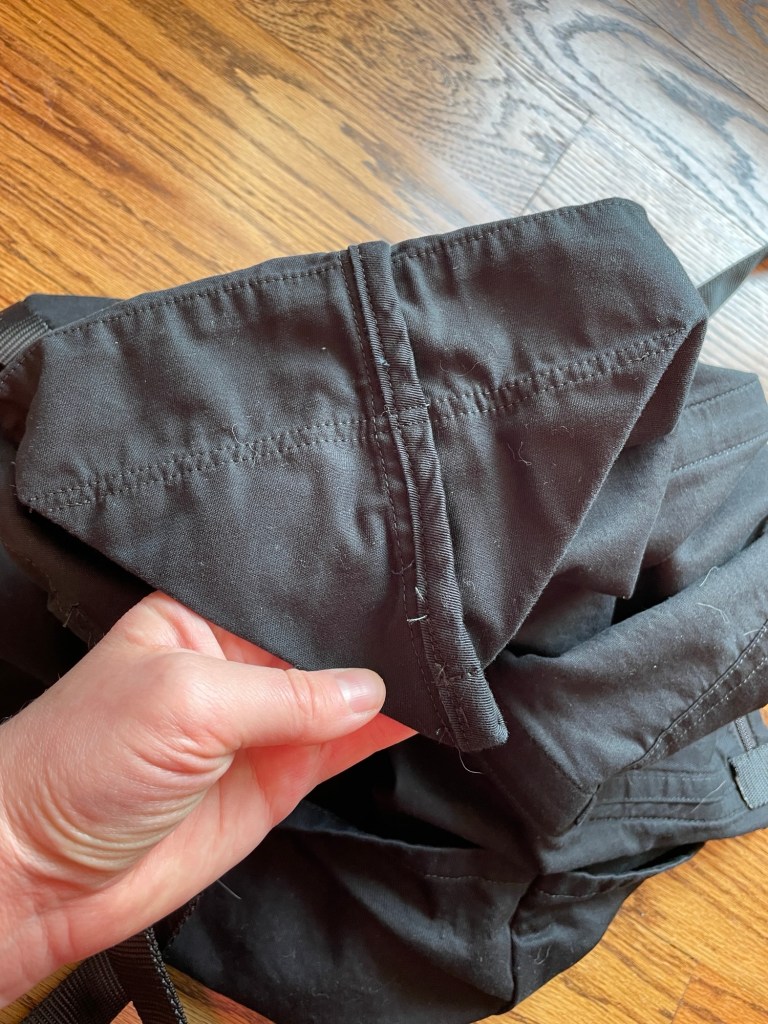
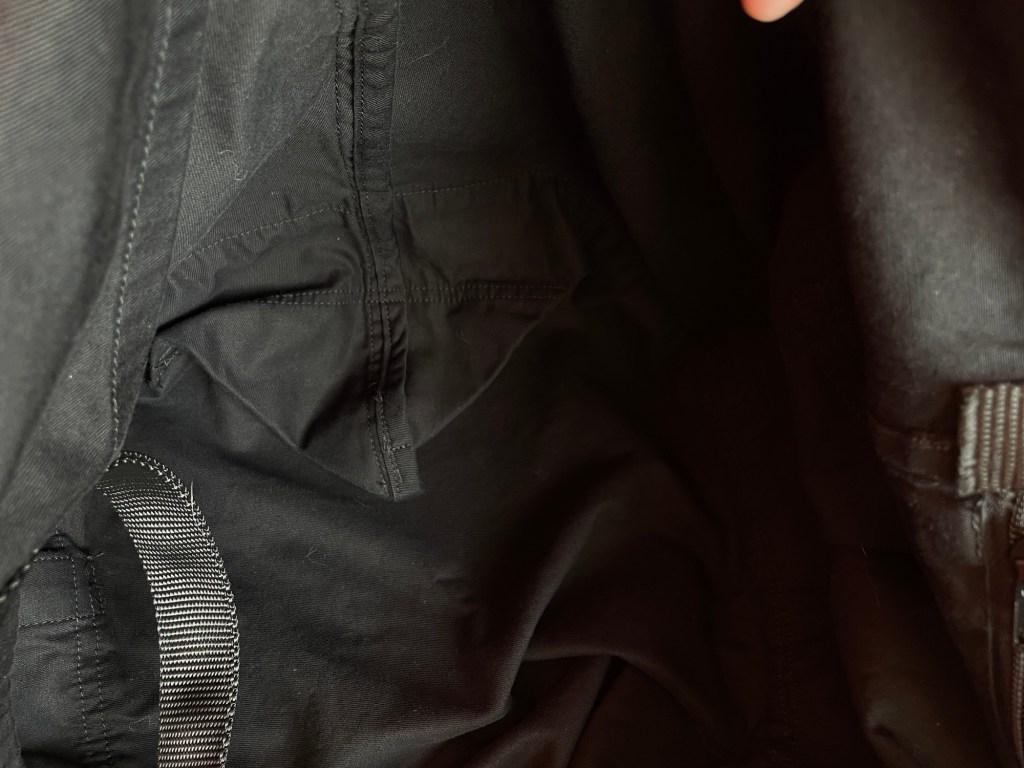
For this version I also added a hanging loop, as I noticed with my other hoodie that I needed to hang it up more than I anticipated.
Jalie 4457 is a pattern for sweatpants and shorts that includes side cargo pockets, side inseam pockets, and back patch pockets with flaps. The pants have a wider straight leg. The waist is finished with elastic that is topstitched in place with one or two rows of stitching (this will vary based on the size you make).
The side seam pockets can be made from one piece of jersey with the facing pocket piece self fabric to help reduce bulk. They hang from where the waistband is stitched, thus reducing bunching.
There’s the normal range of Jalie sizes, from 2T to women’s plus size 2X. I think they have an extended size pattern also available on their website that has more plus sizes. You can make these for men too though, especially if you are willing to shorten the back crotch curve for their typically flatter butts.
Materials
Jalie suggests sweatshirt fleece, French terry, and heavier jersey with at least 20% stretch across the grain.
I used a mid weight French terry with a brushed, fleecy back from Fabric Mart with 20% stretch widthwise and 40% stretch along the length. It is sooo soft and has great drape – perfect for the wider legs of this pattern!
Fit and Alterations
Based on my hip size I made a AA. I cut a size Z for the waistband elastic.
I left off the side cargo pockets. Maybe I will add them to summer shorts. I mostly bought this for the cut, not the cargo detail.
For alterations I lengthened the legs 1.25”. I probably only need an inch but I like to allow a little bit of extra fabric for new pants as I have noticed no matter how much I preshrink, as time goes on the length tends to contract. I also added 3” at the center back seam, tapering to nothing at the center front.
The 3” seems like such a dramatic amount of height to add, but a couple of years ago I got some pajama pants from Lands End that fit really well (balanced at the waist, no pulling down in the back when sitting) and when I measured them I discovered it was because the back crotch curve was so much longer/taller than the front. I use these measurements as a guide now for altering pants.
Construction
Jalie has great instructions for this pattern, perhaps even better than some of their old patterns. The pattern sheet is also color coded for the lines rather than the old style pattern sheets which are all black and white, which makes it very easy to trace your size.
The entire pants pattern uses 3/8” seam allowances, not 1/4”. You sew on a regular sewing machine then finish the edges on a serger as you go along. When it comes time to do the waistband casing you finish the edge with a serger then fold it over and stitch in place. This makes for a lot less bulk than folding the edge under. Also, when you make the front side seam pockets you baste them 3.25” (for my size) from the upper waistband raw edge, then trim close to the stitching. This way when you make the waistband casing the raw edges are caught in the seam, but you don’t have any extra bulk.
When I added the back pockets and flaps I used Design Plus fusible web tape to hold everything in place. Highly recommend over pins!
I recommend that after you sew the waistband casing in place and pull through the elastic that you try them on and adjust the gathering before topstitching the elastic in place. The first time I just went ahead after evenly gathering all around and the pockets were gaping with a lot of diagonal pulling towards the front. When I unpicked the topstitching (needed something to do after I couldn’t fall asleep after my son woke up) I adjust the gathers so there was almost none at the front and they were mostly in the back. Much better! The side seams were straight, the pockets flat, and the front was much flatter and more flattering.
Conclusion
Great comfortable sweatpants and shorts pattern for the slightly stretchier heavier knits out there.
I have a gorgeous bamboo fleece from Nature’s Fabrics in my stash I want to use for this pattern, but since I wasn’t sure about the fit or construction I decided to use something less precious for my first version, a cotton/poly sweatshirt fleece from Fabric Mart. It has about 20% mechanical stretch. I would not go below that amount of stretch for this pattern.
For the rib knit I used a pretty beefy rib knit from Jumping June Textiles. It ended up being lighter and paler in color than I had hoped for, but the quality is excellent.
The zipper is a #5 YKK metal zipper from WAWAK. The hood grommets are #00 metal grommets, also from WAWAK. The twill tape used for the drawstring and to finish the seam attaching the hood to the rest of the hoodie is from Amazon.
Fit
I cut a size 44 for most of the hoodie. For the hem band I cut a size 48. The hip of the hoodie where it meets the hem band is around a size 46. The hem band has negative ease so you stretch it to fit the hem of the fleece. I also made the sweatshirt length size 48 so I wouldn’t have to shorten my zipper.
I found the fit was spot on, though a bit on the snug side due to the lower stretch and lack of Lycra in my fabric. The sleeve and hem length were perfect for me. I didn’t know how I’d feel about the wide cuffs (about 3.5” wide) or wide hem (around 4”) but I like them! When I’m working in the kitchen I can just flip up the cuffs instead of pushing them up, and the hem band gives a good fit around my hips.
Construction
Ottobre instructions assume you’re using one of those cover stitch machines that does the faux RTW flatlock stitch. I don’t have one so I serged the edges together and any topstitching was done on my regular sewing machine. The seams were mostly sewn on my serger.
Once again when it came time to sewing on the pockets I used the Design Plus fusible web tape from The Sewing Place. It makes it SO much easier to do any sort of topstitching for tabs, pockets, etc when working with knits.
I should also mention the PDF download layers the pattern pieces onto the paper (much like the pattern sheets do) and no seam allowances are included. I actually prefer this as it’s less sheets to tape together and it forces me to trace onto tracing paper rather than take a shortcut and put the paper pieces directly onto the fabric.
These yoga pants have a bootcut leg, optional topstitched seams, and and upper and lower waistband which can be used with a contrast fabric. The waistband is secured with 3/8” elastic at the upper edge. The back is split into two pieces, which is great if you’re like me and always dealing with gaping at the center back!
As usual with Jalie, the enormous size range goes from child size 2 to adult women’s 22 (so hip sizes 22”-53”)
Materials
Jalie recommends fabrics with 50% minimum stretch in both the width and length.
For my first version (not shown as it is in the laundry!) I used light-to-medium weight cotton/lycra French terry with around 50% stretch in both directions from Fabric Mart.
For my second version (which is shown in the photos above) I used an Italian viscose/lycra French terry from Gorgeous Fabrics.
Fit
I made size AA based on my hip measurement, and did the following alterations:
Added 3” to height of center back seam. I am unsure if for future versions I would keep this much height. On one hand I love how when I bend over it is super secure. On the other hand, after being worn for a while it seems like it was a bit too much as when the day goes on the fabric relaxes and I end up feeling like 2-2.5”may have been enough. For the two versions I made the extra height isn’t a deal breaker.
Added 1” length to the inseam.
Took in the waist slightly, using a size Z and snugging in the elastic to a size Y. I took in the waist entirely at the back leg seams.
Both of the pants fit really well, and are SUPER comfortable. They avoid the RTW fit issues of feeling too tight in the legs while being too loose in the waist, and the fabrics are simply heavenly. This is my go-to pattern for stretchy knit pants now.
Construction
These are a simple sew. I only used my sewing machine for stitching the waistband elastic ends together and then zig-zagging the elastic to the upper waistband edge. It was otherwise constructed entirely on my serger and cover stitch machines. Jalie provides good instructions with both text and illustrations.
Ottobre 5/2012 #11 is a fitted v-neck tshirt with long narrow sleeves and pleats at the bust held in place with a self fabric tab. It comes in sizes 34-52 which is standard for Ottobre.
I had been admiring this pattern ever since I first saw it in 2012!
Materials
Ottobre’s sample was made from a viscose/lycra jersey with 30% stretch. No indication of it was 4-way or 2-way stretch.
I used a very stretchy rayon/lycra jersey from Gorgeous Fabrics.
Fit
I made a size 44 and added 4” to the hips. Based on my previous experience with the two other t-shirt patterns in this issue (which use the same block) I made the next few alterations:
Took in the upper chest 3/8” by doing a narrow shoulder alteration and easing in the back shoulder seam into the front. I feel like the upper chest ran wide on this pattern, but this also could have been my very stretchy fabric.
The length is LONG on this pattern. I shortened the sleeves 1.25” and trimmed off 1.5” from the body hem.
The sleeves were quite tight, especially around the elbow area. If you look at the pattern pieces the sleeve actually curves in at the elbow, instead of going in a straight line. I cut the sleeves in a straight line.
Construction
I love how this top looks, but the construction was a huge pain in the butt.
The neckline is beautiful but it took me several tries to get it right. This fabric is thin and stretchy and wiggly and unforgiving. The pattern doesn’t include markings for the front neckline pleats. You’re supposed to arrange them yourself based on how it fits. I just took a guess and made about five 1/4” wide pleats. I then faced a lot of issues with getting the front tab stitched in place in a way that looked professional and not wonky. I was not going to let it defeat me. I finally got it to work by doing the following:
Interfaced the front tab with a lightweight interfacing.
Once I secured the pleats in place with a row of stitching at the center front, I took a piece of iron-on tear-away stabilized and fused it to the wrong side.
I attached double-sided fusible web to the wrong side of the tab, then fused it to the center of the pleats before stitching.
All three of these steps FINALLY got me an evenly stitched front neckline.
It took me a few tries but I also finally got the v at the front neckline stitched more or less evenly as well.
Ottobre doesn’t give a measurement for the front neckline binding. Based on my fabric stretch I cut it to 85% of the length of the neckline.
Once the front neckline was finished it was super easy to construct the rest of the top. I’ve made all three of the t-shirts in this issue and this is my favorite view, even though construction of the neckline is not the easiest. I love it both worn alone and under my new Ottobre hoodie!